Back
Why an electric car is the right choice — and not just because petrol prices are rising.
Petrol prices have risen – and many people are now thinking about switching to an electric car. That makes total sense, but not only because of prices at the pump.
30th June 2026

In short:
An electric car is not only worth it because of high petrol prices at the moment. For drivers in Switzerland, an electric car means lower running costs, fewer visits to the garage, possible tax benefits and a calmer driving experience. Used electric cars are especially interesting right now because they often offer lots of equipment, good battery values, as well as attractive leasing rates and prices. The biggest advantage: more peace of mind in everyday life — fewer repairs, fewer garage visits, and less drama around the car.
Since the US attack on Iran, petrol prices have risen. In May 2026, the petrol price temporarily reached CHF 1.93 per litre for unleaded 95 – 17% more than in January. For diesel, it was even 20% more than at the start of the year. For a VW Golf, a full tank therefore cost you 15 francs more, and for diesel almost CHF 20 more than back in January – especially for frequent drivers, such an increase really adds up.
Now many people are asking themselves whether they should switch to an electric car. The argument is usually that electricity prices remain more stable and cheaper than oil prices.
"It is not only about electric cars having cheaper running costs – but about an electric car simply giving you less hassle."
But electric cars are not worth it only because of petrol or electricity prices. They are worth it because they create less stress in the long term – and not only financially. Fewer garage visits. Fewer unexpected repairs. Less noise and shaking while driving. Software that keeps itself continuously up to date. And for used cars: better prices.
Gowago shows you why electric cars cause fewer headaches and why right now is the perfect moment to switch. Let’s Go.
- Better for the budget: Are electric cars really more affordable to own?
- Future-proof: How over-the-air updates keep your electric car modern, even as a used car.
- Better as a used car: Why used electric cars are the more reliable used cars.
- Better to drive: Why electric cars are the better cars – regardless of price.
- Conclusion
Better for the budget: Are electric cars really more affordable to own?
Yes, the running costs for an electric car are cheaper than for a traditional diesel or petrol car.
- Electricity, even at a public Supercharger, is cheaper than filling up with petrol. That is how it is, and that has already been the case for the last 10 years. And calculated over annual costs, you save several thousand francs.
- Maintenance is less intensive and cheaper. An electric car has far fewer parts that wear out, break and need to be replaced. No gearbox, no clutch, no oil to change, no V-belt. And that is exactly what makes them so attractive as used cars.
- Depending on the canton, you pay less or no road traffic tax at all – in some cases, that amounts to several hundred francs per year.
How much cheaper it really is to drive on electricity than petrol
In short:
- With an electric car, the costs are more predictable because electricity prices are more stable.
- You are less affected by geopolitical crises in the Middle East.
- With CHF 100, you can drive 800 km in a petrol VW Golf, but up to 2,260 km in a Tesla Model 3.
Oil prices have been rising steadily since the 1990s. Since 1992, petrol prices in Switzerland have more or less doubled. As soon as crises emerge in the Middle East, costs can shoot up rapidly in the short term and your monthly budget for driving can suddenly become much higher.
Of course, electricity costs are also changing – household electricity prices have also risen in recent years. However, price fluctuations are more stable overall and that makes your monthly budget for the electric car more predictable.
Electric driving comes out clearly cheaper – and has done so for years. Let’s compare two cars that are really popular in Switzerland: a petrol VW Golf and a Tesla Model 3.
"With an electric car, you get more range per franc and your monthly budget is less vulnerable to sudden price fluctuations."
Both are mid-range cars, both offer roughly the same amount of space, are roughly the same size and have similar prices. With a full tank in the Golf (50 litres) and a full charge in the Model 3 (75 kWh), both cars have a similar range – for a simple cost comparison, we are calculating with around 600 km of range.
(In reality, range of course depends heavily on the model, driving style, temperature and route – but the order of magnitude clearly shows how different the energy costs are.)
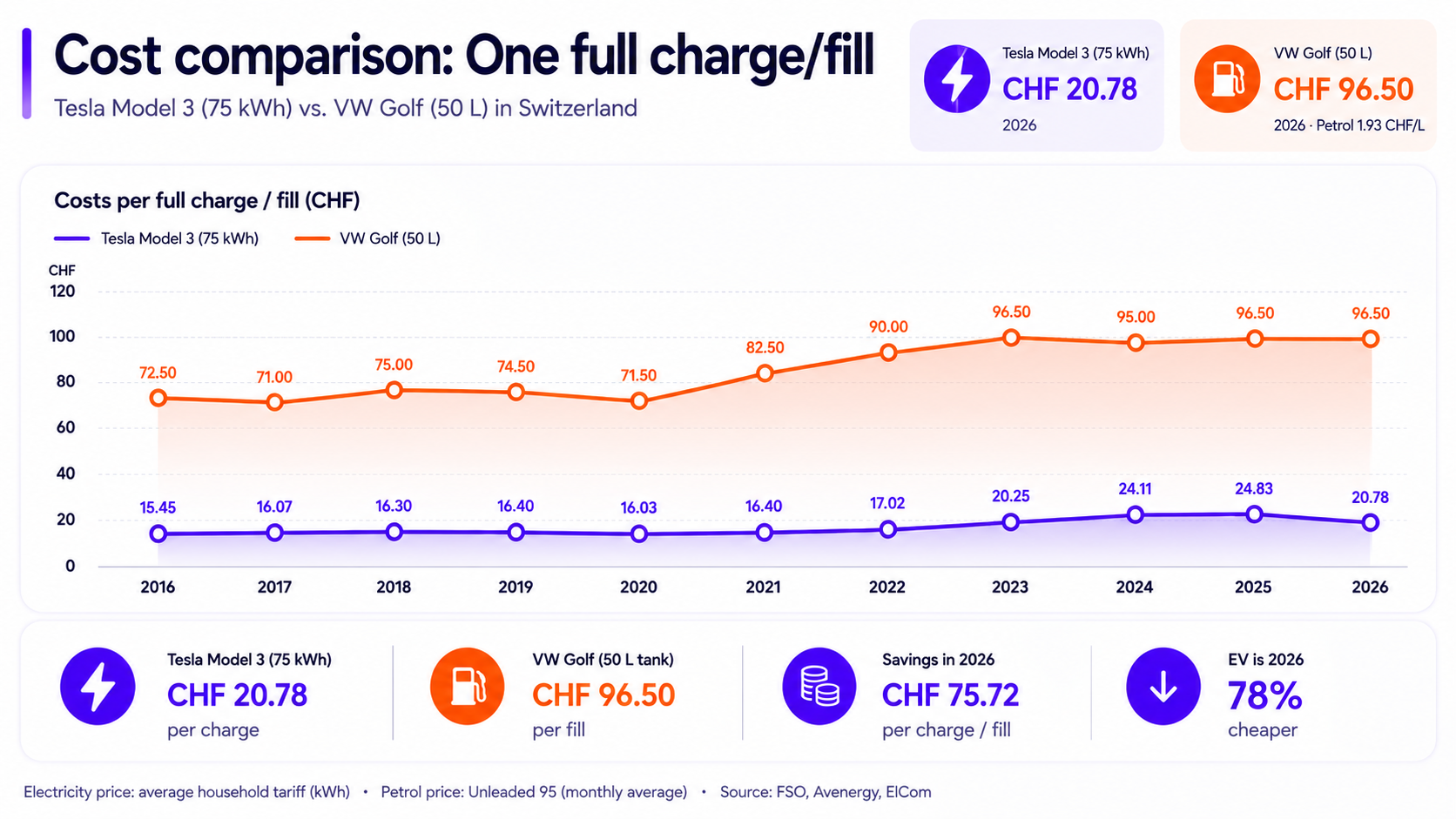
The graphic shows: For the same range, you currently pay 4 times as much with the Golf. Over the last 10 years, petrol has always been significantly more expensive than electricity. With an electric car, you therefore get significantly more range per franc.
The everyday costs differ massively. At Gowago, we see that 15,000 km per year is one of the most frequently selected kilometre packages. That is why we are calculating with exactly this value in this example.
For the Golf, you would pay around CHF 1,930 per year for petrol. With the Model 3, the electricity for the same number of kilometres simply costs 630 francs – one third of the cost of petrol. You save CHF 1,300 per year with the electric car – or CHF 108 per month.
*For the calculation, we assume an average household electricity price in Switzerland of 32 centimes per kWh and an average consumption of 16 kWh/100 km for the Tesla Model 3. For the Golf, we calculate with 6.5 l/100 km and a petrol price of CHF 1.93 per litre.
Why charging an electric car puts less strain on your monthly budget – the direct comparison
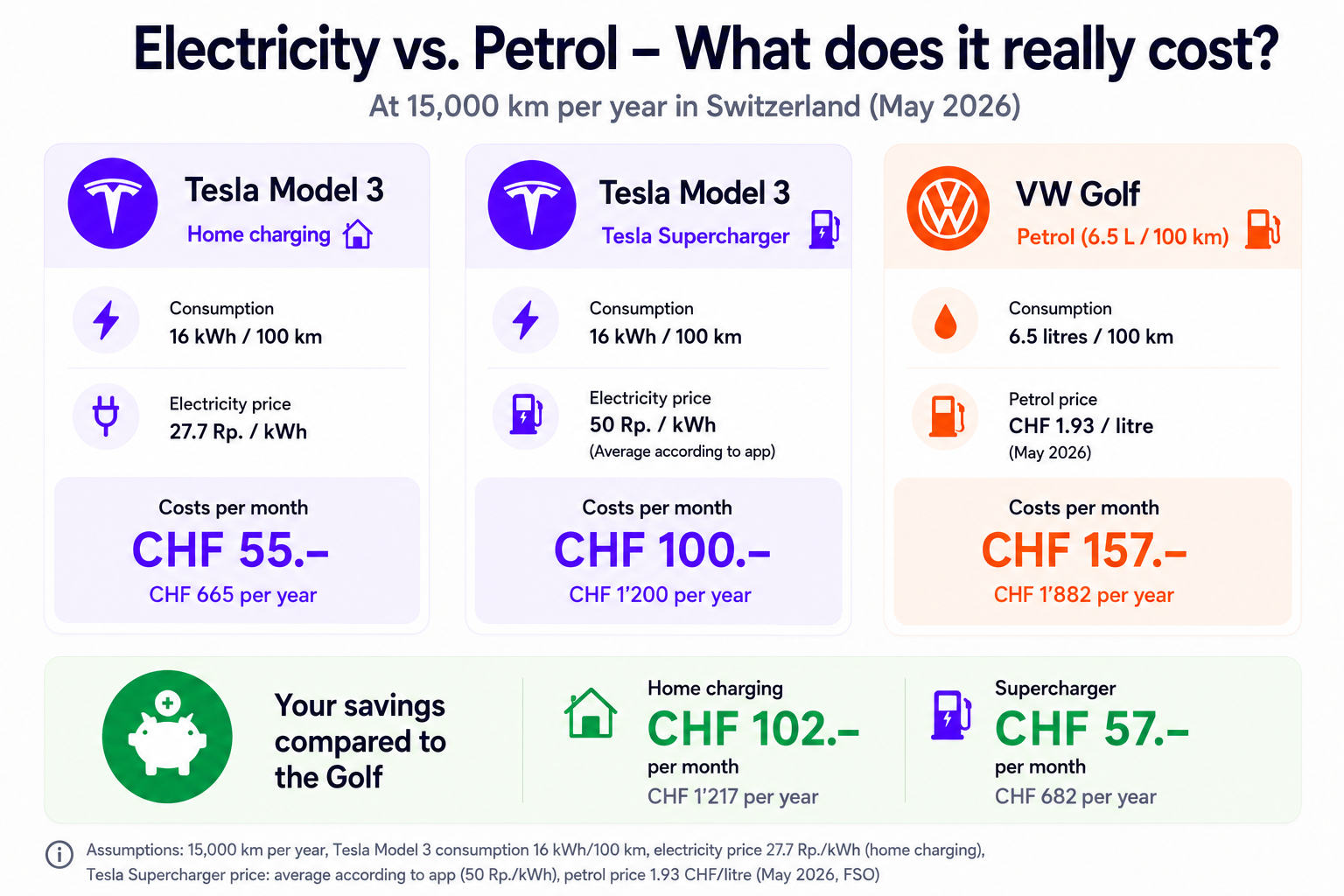
When commuting, on holiday journeys or during weekend shopping – with an electric car, you drive cheaper immediately and every time. Especially when commuting, the savings can be enormous.
In practice, this would mean the following costs for you:
| Category | Route | Golf | Model 3 (home charging) | Saving |
|---|---|---|---|---|
| Commuting | Agglomeration Zurich → Zurich | CHF 83 | CHF 25 | CHF 58 / month |
| Commuting | Winterthur → Zurich | CHF 138 | CHF 42 | CHF 96 / month |
| Commuting | Lausanne → Geneva | CHF 358 | CHF 108 | CHF 250 / month |
| Commuting | Bern → Zurich | CHF 690 | CHF 208 | CHF 482 / month |
| Shopping | Zurich → Constance | CHF 8.80 | CHF 2.65 | CHF 6.15 / trip |
| Skiing | Zurich → Zermatt | CHF 30.75 | CHF 9.25 | CHF 21.50 / trip |
| Holidays | Zurich → Milan | CHF 35.15 | CHF 10.60 | CHF 24.55 / trip |
| Holidays | Basel → Cinque Terre | CHF 74.00 | CHF 22.30 | CHF 51.70 / trip |
On daily journeys between the agglomeration and the city, you save around CHF 700 per year – depending on the car, with this saving you have already paid your road traffic tax or your gym membership. If the commuting route is longer, such as Bern–Zurich, you save even more with an electric car: 5,800 francs per year. It is as if you simply get a fat bonus at the end of the year.
"The savings per trip or per charging/fuelling stop may seem small – but calculated across the whole year, you save massively, especially as a commuter."
For holiday journeys, the savings are not necessarily enormous – but lunch as soon as you arrive, or the first night in the AirBnB in the Cinque Terre, is already paid for with those CHF 50 francs.
This is how we calculated: For commuting routes, we calculate with 20 working days per month and a return journey. For individual routes such as holidays or skiing, we calculate with a one-way journey. The distances are based on typical routes, and the consumption values on realistic average values for a petrol VW Golf and a Tesla Model 3. For the electric car, we calculate in the first example with home charging, and in the second with CHF 0.50/kWh at the Supercharger.
With a Tesla, you have the easiest and most affordable access to out of home charging.
Discover Tesla offers on Gowago
Is public charging also cheaper than petrol?
Yes, even public charging usually costs you less than petrol or diesel, especially at a Tesla Supercharger – one kilowatt-hour there usually costs you between 40 and 80 centimes. By the way, you can use Superchargers with any electric car – they simply cost a little more than if you charge there with a Tesla.
So far, we have calculated with average home charging prices. But what if you cannot charge at home?
Even then, the electric car is cheaper – especially at the Tesla Supercharger. In Switzerland, there are around 30 Supercharger locations on the main transport routes. If you drive from Ticino to Zurich, for example, you have a Supercharger in Quinto, Airolo, Flüelen and Affoltern.
As of 2026, Tesla Supercharger prices in Switzerland often range roughly between CHF 0.40 and CHF 0.80 per kWh depending on location, time of day and utilisation. You can see the exact prices at any time in the Tesla app.
"Home charging may be the best option – but public charging is no longer a reason to decide against an electric car."
For Teslas, charging at Superchargers is always a little cheaper, but you can also charge there with a Polestar, VW, Audi and any other electric car. All you need is the Tesla app – which, by the way, also immediately shows you the occupancy of the charging station as well as the cost of charging. Plus: The prices are at the same level across Europe. That makes longer journeys more predictable and avoids all the frustration that people otherwise know from electric car charging stations.
Charging at a Supercharger is definitely cheaper than petrol or diesel. Let’s calculate with the average of 50 centimes per kilowatt-hour at the Supercharger. With an electric car, you simply get much more range for your money. With CHF 100 francs, you get furthest on average with the electric car, even if you charge at the Tesla Supercharger:
| For CHF 100 you get... | Range |
|---|---|
| 🏠 Tesla Model 3 (home charging) | ≈ 2'260 km |
| ⚡ Tesla Model 3 (Supercharger) | ≈ 1'250 km |
| ⛽ VW Golf | ≈ 800 km |
Imagine it like flight tickets. You have a travel budget of CHF 100 francs. With one airline, you get as far as London, Barcelona, Split or Naples. But with the other airline, for CHF 100 you get flights to Crete, the Algarve, Turkey, or even almost as far as Gran Canaria.
"Commutes, shopping trips or holiday trips are also cheaper than petrol when charging publicly at the Supercharger."
Above, we calculated the prices for common commuting and holiday routes with home charging for you. Now the same exercise again – but with the average price at the Supercharger – and you can see that even then, charging is significantly cheaper than filling up.
| Category | Route | Golf | Model 3 (Supercharger only, CHF 0.50/kWh) | Saving |
|---|---|---|---|---|
| Commuting (per month) | Agglomeration Zurich → Zurich | CHF 83 | CHF 45 | CHF 38 / month |
| Commuting (per month) | Winterthur → Zurich | CHF 138 | CHF 75 | CHF 63 / month |
| Commuting (per month) | Lausanne → Geneva | CHF 358 | CHF 195 | CHF 163 / month |
| Commuting (per month) | Bern → Zurich | CHF 690 | CHF 375 | CHF 315 / month |
| Shopping tourism (per trip) | Zurich → Constance | CHF 8.80 | CHF 4.75 | CHF 4.05 / trip |
| Skiing (per trip) | Zurich → Zermatt | CHF 30.75 | CHF 16.70 | CHF 14.05 / trip |
| Holidays (per trip) | Zurich → Milan | CHF 35.15 | CHF 19.10 | CHF 16.05 / trip |
| Holidays (per trip) | Basel → Cinque Terre | CHF 74.00 | CHF 40.25 | CHF 33.75 / trip |
Depending on the situation, route or electric car, you do not necessarily charge at a Supercharger. And I am being honest here – the prices, locations and apps around the other charging stations in Switzerland are a bit of a Wild West. That needs to get better. In fact, the federal government is currently working on taming the price jungle around charging. Until then, I really advise you to drive to a Supercharger where possible.
And to make charging at public stations easy and hassle-free in your everyday life, there are a few tricks – you can read more about this in our blog article on the topic.
Fewer garage visits: Does an electric car really need less maintenance?
Yes. An electric car is mechanically much easier to care for because there are fewer moving parts. Clutch, clutch, spark plugs, engine oil – none of this exists in an electric car. As a result, it needs less servicing and the service is usually cheaper.
Typically, servicing with a combustion car works as follows: You get into the car in the morning, a warning gong sounds and the dashboard says “Service due in X days”. Then the hassle begins: call the garage, make an appointment, drive a detour to the garage early in the morning, drop off the car and continue by public transport. In the evening, the whole thing happens again in reverse.
In the best case, the service only consists of an oil and fluid change, a technical inspection and a basic clean – costing a few hundred francs. In the worst case, expensive repairs for wear parts such as brakes, the clutch, the V-belt or seals have to be done.
"Maintenance intervals with a petrol car. Let's be honest: they are annoying, expensive, and need to be done far too often. You haven't got that issue with an EV – especially, if you drive a Tesla."
Saving costs by simply skipping the service? Not a good idea. With missed service intervals, you risk problems with the manufacturer warranty, when returning the car after leasing, when selling the car, or simply with the mechanics. You have to change your oil regularly, otherwise in the worst case you can end up with engine damage.
With an electric car, you do not have to deal with that. Maintenance and servicing are significantly less time-consuming, less costly and less annoying with an electric car.
An electric car is mechanically much simpler in design. That leads to less extensive service work. Everything that gets worn out and consumed in a combustion car – oil, clutch, V-belts and timing belts, starter motor, turbo, seals, gearbox, cylinders – does not exist in an electric car. Thanks to recuperation, even the brakes wear less.
"What is not installed cannot break. Electric cars are mechanically far less complex and therefore less prone to expensive repairs and service costs."
Because electric cars have fewer classic wear parts, many typical service tasks of a combustion car disappear: no oil change, no clutch, no timing belt, no turbo, no classic gearbox. For you, that means: lower costs. Fewer visits to the workshop. Less hassle.
Tesla is particularly consistent with this through its mobile service. Tesla sends the technician to your car on request, regardless of whether it is at your home, at your workplace or in any publicly accessible garage. As soon as you come back to the car, the necessary service is done. That is only possible because a Tesla, as an electric car, has simple service work – a lifting platform and so on is not even necessary.
"With a Tesla, you do not even have to go to the garage – Tesla can carry out hundreds of tasks wherever your car is parked."
But mobile service does not only take care of servicing – hundreds of other tasks can also be done by Tesla in this way. Defective door handle, fitting a tow bar, rattling sound system – simply select the problem in the Tesla app and book a mobile service. That’s it. It has never been this easy.
A Tesla makes driving easier for you. And Gowago makes the way there easier for you. Choose your Tesla, configure your lease and sign your contract – all 100% online. Easy. Fair. Transparent.
Discover Tesla offers on Gowago
Lower taxes: How much do I save with an electric car on road traffic tax?
How much you save depends on the canton. Electric cars currently benefit in 19 out of 26 cantons from a lower or completely waived road traffic tax. The calculation system is different in every canton (hooray for federalism) – which means it can get a little complicated.
But do not worry, we will simplify it for you and compare two of the most popular SUVs in Switzerland: the BMW X3 and the Tesla Model Y. The savings on road traffic tax can be enormous.
| Canton | BMW X3 | Tesla Model Y | Annual saving |
|---|---|---|---|
| Bern | CHF 494 | CHF 259 | CHF 235 |
| Basel-Landschaft | CHF 651 | CHF 389 | CHF 262 |
| Basel-Stadt | CHF 544 | CHF 300 | CHF 244 |
| Fribourg | CHF 571 | CHF 432 | CHF 139 |
| Glarus | CHF 407 | exempt | CHF 407 |
| Graubünden | CHF 570 | CHF 105 | CHF 465 |
| Neuchâtel | CHF 534 | CHF 250 | CHF 284 |
| Nidwalden | CHF 340 | CHF 95 | CHF 245 |
| Obwalden | CHF 368 | CHF 125 | CHF 243 |
| St.Gallen | CHF 590 | exempt*** | CHF 590 |
| Solothurn | CHF 351 | exempt | CHF 351 |
| Thurgau | CHF 288 | CHF 48**** | CHF 240 |
| Ticino | CHF 500 | CHF 260 | CHF 240 |
| Uri | CHF 454 | CHF 353 | CHF 101 |
| Vaud | CHF 563 | CHF 112 | CHF 451 |
| Valais | CHF 269 | CHF 160 | CHF 109 |
| Zug | CHF 330 | CHF 250 | CHF 80 |
| Zurich | CHF 458 | exempt | CHF 458 |
Depending on the canton, you therefore save a lot. For example in St. Gallen: There, you would save 600 francs per year in a Model Y. That is enough to go away for a weekend, finance your gym membership, or buy the Christmas presents.
If you add up the population of all cantons with tax benefits for electric cars, it turns out that around 80% of people in Switzerland could be driving more cheaply from a tax perspective with an electric car. So the chances are high that you live in a place where switching to an electric car could be worthwhile.
You can read how much you would pay for your electric car or petrol car in our blog article on Swiss road traffic taxes.
Future-proof: How over-the-air updates keep your electric car modern, even as a used car
In short: A combustion car is static – an electric car keeps developing and the software always stays up to date.
This is one of the most attractive points for an electric car, or for a used electric car: it is never really outdated. Because everything is software-controlled, the car can essentially be adapted and improved from A to Z with updates. As a result, a used electric car can keep up with new cars. With a petrol or diesel car, this option does not exist.
If you buy a 2.0-litre Golf diesel that consumes 6 litres per 100 km, then in 10 years you will still have a 2.0-litre Golf diesel that consumes 6 l/100 km. The car stays exactly the same.
With an electric car, almost everything can be optimised with over-the-air updates: performance, efficiency, safety systems, infotainment, suspension. The hardware stays the same – but the software is brought up to date. And without having to go to the garage.
"Your electric car even gets better over time. New, clever features come to your car automatically via software update – without a garage visit."
Overnight, in the car park, the update is installed. Then you get into your electric car in the morning and drive a car with the latest software that feels fresh and ultra-modern again – even if the car is actually already a few years old.
Tesla is the market leader in over-the-air updates. All the innovative, clever and user-friendly features Tesla is known for once arrived as over-the-air updates: Dog Mode, Sentry Mode, Grok AI, as well as updates to performance, battery and performance.
And soon Full Self-Driving will arrive, also via over-the-air update. That means from one day to the next, you suddenly have a self-driving car – without a garage visit.
Better as a used car: Why used electric cars are the more reliable used cars
In short: With a used electric car, you get a used car without that uneasy feeling. Because the typical problems you almost expect with a second-hand combustion car – signs of wear in the gearbox, clutch or engine – do not exist in electric cars because they are mechanically simpler and age better.
Whether you have already driven your combustion car yourself for 45,000 km or you lease it used with 45,000 km: slowly, an uneasy feeling sets in. When will the first big repair come? What is that strange noise while driving? Was it always there, or is it new?
Because a petrol or diesel car is so mechanically complex – around 2,000 moving parts – a lot can go wrong, especially over time. And the older the car is, the higher the likelihood that something has to be replaced: new spark plugs, replacing the V-belt, renewing brake pads, replacing the clutch – all normal wear repairs. People know it, accept it and plan accordingly.
With an electric car, however, none of this is a problem.
Mechanically, an electric car ages more calmly than a combustion car in many areas – even with 100,000 km on the clock, you barely need to worry about wear in an electric car. All the parts that eventually have to be replaced in a combustion car or cause problems are not even present in a used electric car. Now and then it might need a new cabin filter, very rarely new brakes, maybe something on the suspension – that is it.
"Because an electric car is so mechanically simple, it is also less delicate and less prone to defects as a used car."
And the batteries? Long-lasting. Experience has shown that battery capacity remains well above 90% for a long time. Analyses by the electric car database Recurrent show that many electric car batteries still retain a very high proportion of their original range even after several years. In many cases, the usable range after five years is on average 95%.
At Gowago too, we see in many used electric cars that battery condition and range in everyday life are less problematic than many buyers fear.
Discover electric cars from Gowago Certified Pre-Owned
Cheaper as a used car: Why used electric cars have the best value for money
At the moment, the narrative is as follows: Electric cars are a bad investment as new cars because they lose their value more heavily and faster than comparable combustion cars.
But as a used-car buyer, that is exactly the huge advantage of a used electric car: You get a car that:
- ages better than a combustion car.
- is still cheaper to maintain as it gets older than a combustion car
- becomes better in performance and efficiency through over-the-air updates
- Still has almost the same range as a new car
- Is significantly cheaper to buy than a used combustion car with more kilometres
In other words, a used electric car is a no-brainer. Few used cars currently offer a similarly strong mix of price, performance, equipment and running costs. You get a Porsche, an Audi, a Volvo, Tesla, Mercedes or BMW – in other words, a luxury car – for the same price as a well-equipped petrol Golf.
| Model | Year / km | Depreciation | Purchase price | Leasing per month |
|---|---|---|---|---|
| VW Golf 1.5 e TSI mHEV Life DSG | 2023 / 80’930 km | 37% | CHF 27’450 | CHF 417 |
| Tesla Model 3 Long Range | 2023 / 49’596 km | 39% | CHF 30’400 | CHF 426 |
| Volvo EX30 E40 Core | 2025 / 12’000 km | 20% | CHF 31’770 | CHF 442 |
| LEXUS UX 300e Excellence Electric | 2021 / 39’100 km | 62% | CHF 24’850 | CHF 355 |
| AUDI Q4 e-tron 45 quattro | 2023 / 38’600 km | 63% | CHF 29’850 | CHF 370 |
| BMW i4 eDrive40 | 2023 / 81’900 km | 61% | CHF 35’850 | CHF 505 |
(Leasing parameters for calculation: 36-month term, 10,000 km per year, 15% down payment)
At first glance, the differences do not look massive. But it is important to distinguish: An electric car with 40,000 km will deliver the same performance and reliability as a new one. Meanwhile, the Golf will soon need the first larger repairs.
Whether Audi, Volvo, BMW or even a Lexus – all these cars are more luxurious, have better equipment and more prestige than the Golf. But they cost a similar amount per month. Really think about that: With a used electric car, you have the chance to drive a premium car for the price of a Golf. That has never existed before.
"Low residual values mean cheap used cars – so with electric cars, you can drive premium for the budget of a Golf."
But you should not take too long to think about switching to a used electric car. Once it becomes known how good used electric cars are, demand will rise rapidly – and prices will move upwards.
But because you are reading our blog article, you know that now is the perfect moment to lease a used electric car. At Gowago, all brands and models are available online – whether Tesla, Polestar, VW, Audi, Volvo or another manufacturer.
Explore used electric cars now
Better to drive: Why electric cars are the better cars – regardless of price.
In short: Apart from the price advantages when buying, leasing, servicing and paying taxes: an electric car is much more pleasant, especially as a commuter vehicle, for longer distances and as an everyday car – less jerky, less engine noise, fewer vibrations.
All the vibrations, noises and jerking when shifting gears probably do not actively stand out to you in a combustion car – and yet they affect your stress level. In an electric car, everything is quieter, more stable, smoother.
"You often only feel the best argument for an electric car when driving. No noise, no jerky pulling away, no vibrations."
I did not want to believe it at first either. But I once had a Polestar 2 for a weekend and drove 500 km with it in one day – 6 hours of driving, including annoying traffic jams. On the same route in a 2 Series BMW, I had felt completely exhausted afterwards. With the electric Polestar, I had no sign of tiredness. I was relaxed and fresh.
If I had to commute every day or constantly drive such long distances, I would buy an electric car for the comfort alone. Then I would have peace and quiet while driving – put on a podcast and done.
Conclusion
If you are already thinking about switching anyway, now is a very good moment – and not because of high petrol prices.
Petrol and energy prices are constantly changing. An electric car has other, much more convincing arguments: lower maintenance costs, fewer garage visits, better longevity, more comfort and currently still lower entry prices for used cars.
More calm, more control and more car for the money. An electric car makes your life easier. Let’s Go.